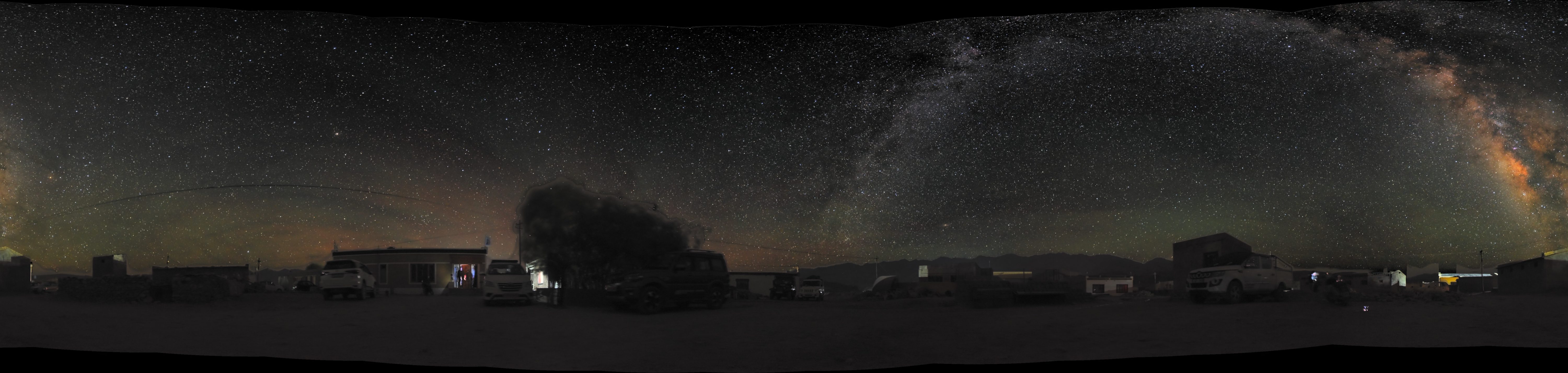
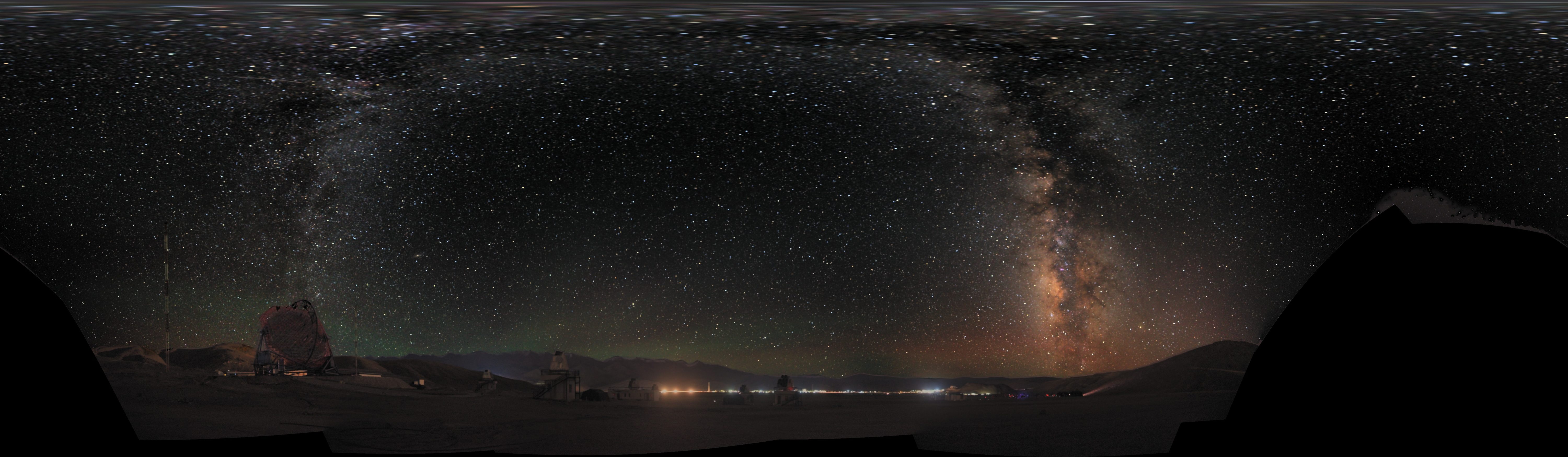
Night-sky panoramas, stitched on the stars
A wide lens still can't hold the whole arch of the Milky Way. Turn the camera between photos, and this page puts them back together: each photo is plate-solved (where it points is found from its stars, with the same engine as Plate Solver), the photos are laid on a panorama about the axis the camera turned around, and their overlaps are blended so the seams don't show. The sky keeps turning while you shoot, so the stars of neighbouring photos are lined up for the moment they're blended, while the ground stays where the camera saw it.
How to shoot
- One spot, a tripod or something steady. Turn the camera about one axis between photos; level it first if you can.
- Overlap each photo with the next by a third or more. The stars in the overlap are what join them.
- Same settings for every photo: manual exposure, ISO and focus. Several photos per direction are stacked for less noise.
- Work quickly: the sky turns a quarter of a degree a minute. It is lined up again here, but the ground's shadows and the glow near the horizon change.
What you get
- A stitched panorama, cut to the rectangle the photos cover, shown as the camera made it (JPEG) or developed (RAW); Natural and Vivid finishes on top.
- A 16-bit TIFF of the blend, and the sky mask, on a computer.